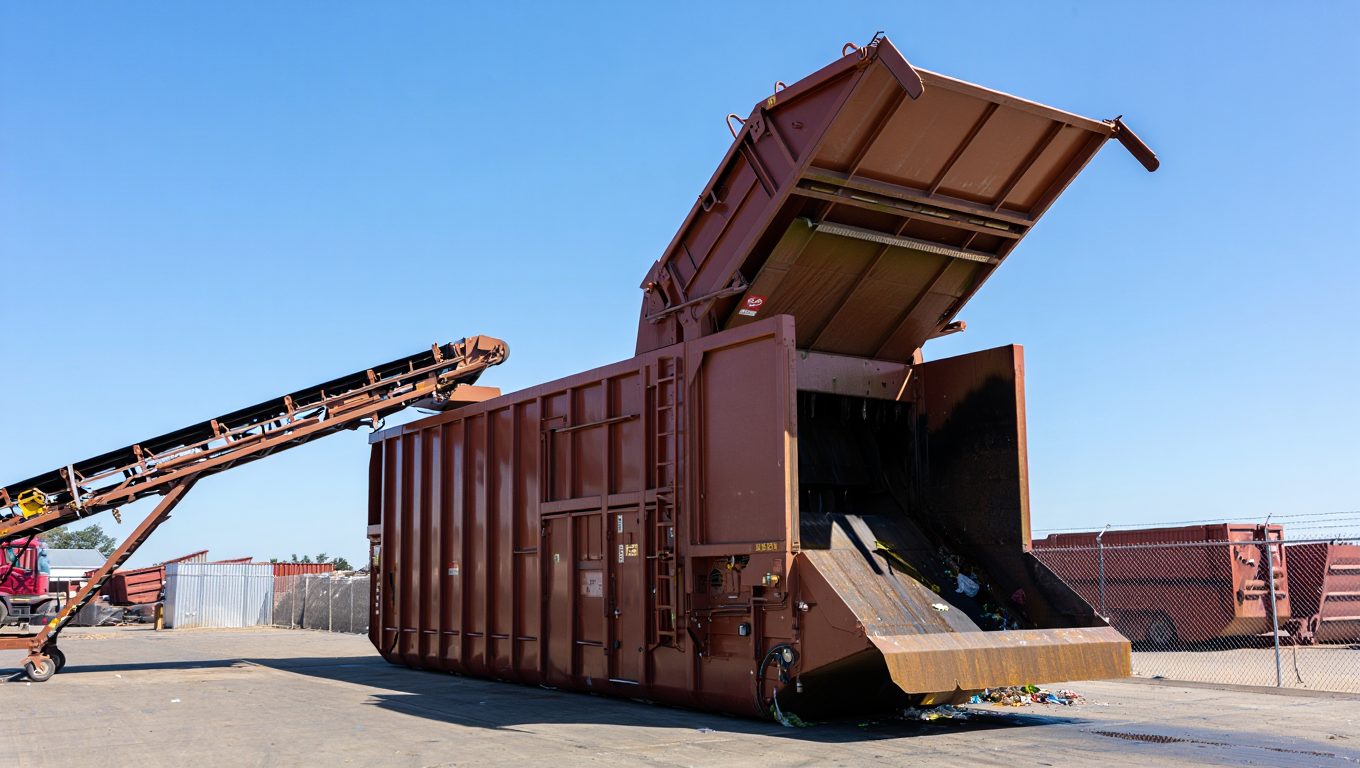
An industrial trash compactor reduces waste volume, lowers hauling costs, and improves site efficiency. Businesses use compactors to cut waste pickups by up to 50 percent or more, leading to fast return on investment. The right system depends on waste type, volume, facility layout, and operational goals.
- Reduce hauling frequency and disposal costs
- Improve sanitation and safety
- Handle wet, dry, or recyclable materials efficiently
- Achieve ROI in as little as 12 to 36 months
What Is an Industrial Trash Compactor?
An industrial trash compactor is a machine that compresses waste materials into a smaller volume for easier storage and transport. It uses hydraulic or mechanical force to reduce the size of trash, recyclables, or organic waste.
Compactors are widely used in warehouses, manufacturing plants, retail stores, and food processing facilities to streamline waste handling and reduce operational costs.
Why Businesses Invest in Industrial Compactors
Waste disposal costs continue to rise due to landfill fees, fuel surcharges, and labor expenses. Compactors address these challenges by improving efficiency and reducing waste volume.
- Lower hauling and disposal costs
- Reduce labor required for waste handling
- Improve site cleanliness and odor control
- Enhance workplace safety
- Increase recycling efficiency
Most systems achieve a 4 to 1 volume reduction or greater, depending on the material.
Types of Industrial Trash Compactors
Stationary Compactors
Stationary compactors are fixed units that compress waste into detachable containers. They are ideal for high-volume dry waste operations.
- High compaction force
- Continuous operation capability
- Dock-fed or chute-fed configurations
Best suited for distribution centers, warehouses, and manufacturing facilities.
Self-Contained Compactors
Self-contained compactors combine the compactor and container into a sealed unit designed for wet waste.
- Leak-proof construction
- Odor control
- Entire unit hauled when full
Common in grocery stores, restaurants, and food processing plants.
Vertical Compactors
Vertical compactors are compact, front-loading units designed for lower waste volumes and limited space.
- Small footprint
- Lower upfront cost
- Indoor installation capability
Ideal for retail locations and small facilities.
Auger Compactors
Auger compactors use a screw mechanism instead of hydraulics, allowing continuous feeding and consistent compaction.
- Reduced maintenance
- Continuous operation
- Consistent density output
Popular in large retail and distribution environments.
Specialty and Custom Systems
Custom systems are engineered for unique waste streams or operational needs.
- Pre-crusher compactors for bulky items
- Multi-chamber recycling systems
- Dock-integrated designs
These systems often deliver the highest long-term efficiency and ROI.
Key Specifications to Evaluate
Compaction Force
Measured in pounds or tons. Higher force improves volume reduction for dense materials like cardboard and plastics.
Container Capacity
- 20 yard
- 30 yard
- 35 yard
- 40 yard
Larger containers reduce pickup frequency but require more space.
Cycle Time
Faster cycle times increase throughput in high-volume operations.
Power Requirements
Most systems require 208V, 230V, or 460V three-phase power.
Loading Configuration
- Dock-fed
- Ground-fed
- Chute-fed
- Cart tipper integration
Safety Features
- Interlocked doors
- Emergency stop controls
- Fullness monitoring systems
- Remote diagnostics
Industrial Trash Compactor Prices in 2026
| Compactor Type | Price Range |
|---|---|
| Vertical | $8,000 to $25,000 |
| Self-Contained | $18,000 to $45,000 |
| Stationary | $20,000 to $60,000 |
| Auger | $30,000 to $75,000 |
| Custom Systems | $50,000+ |
Total project cost may also include freight, installation, electrical work, and site preparation.
Factors That Influence Industrial Compactor Cost
- Waste volume and material type
- Site access and layout constraints
- Installation complexity
- Customization requirements
- Service and maintenance support
How to Calculate ROI
Step-by-Step Process
- Calculate current hauling costs
- Estimate reduced pickups after compaction
- Compare savings to equipment investment
Example:
- $450 per haul, 3 times per week = $70,200 annually
- Reduced to 1 haul per week = $23,400 annually
- Annual savings = $46,800
In this scenario, a $40,000 system pays for itself in under one year.
Additional ROI Benefits
- Reduced labor costs
- Improved safety conditions
- Cleaner facility appearance
- Lower pest control expenses
- Higher recycling rebates
Experience-Based Insights
In real-world applications, the biggest ROI gains come from matching the compactor to the waste stream. Facilities that choose undersized or mismatched equipment often face higher maintenance costs and reduced efficiency. Proper system sizing and layout integration are critical for long-term performance.
Working with a provider that understands new equipment options and application-specific design helps avoid costly mistakes.
Choosing the Right Equipment Partner
- Application-specific engineering expertise
- Proven installation experience
- Reliable service and maintenance support
- Parts availability and response time
- Warranty coverage
Explore available industrial compactor systems to compare configurations based on your operation.
Some facilities also consider used equipment options to reduce upfront investment.
2026 Industry Trends
- Smart fullness monitoring systems
- Remote diagnostics and predictive maintenance
- Energy-efficient hydraulic systems
- Increased recycling integration
- Data-driven waste management reporting
Advanced systems are increasingly integrated with sorting systems to improve recycling efficiency.
Frequently Asked Questions
How much does an industrial trash compactor cost?
Industrial trash compactors typically cost between $8,000 and $75,000 or more. The final price depends on equipment type, size, customization, and installation requirements. Total project costs may also include freight, electrical work, and site preparation.
What determines trash compactor prices?
Prices are influenced by compaction force, container size, waste type, and system complexity. Additional features like cart dumpers, automation, and custom integrations can increase total cost but often improve long-term efficiency.
How much space is required?
Space requirements vary by compactor type. Vertical compactors require minimal floor space, while stationary systems need dock access and room for container removal. Site layout and loading method play a key role in system selection.
How long does installation take?
Most industrial compactor installations are completed within one to three days. Timeline depends on site preparation, electrical work, and whether custom fabrication or structural modifications are required.
What is the typical ROI timeline?
Most businesses see return on investment within 12 to 36 months. High-volume operations often achieve payback faster due to significant reductions in hauling frequency and labor costs.
Bottom Line
An industrial trash compactor is a high-impact investment that reduces waste costs, improves efficiency, and enhances facility operations. The best results come from selecting the right system based on waste type, volume, and site conditions, combined with reliable installation and service support.
Get Expert Guidance
Selecting the right system requires evaluating your specific waste stream and operational goals. Action Compaction designs and installs durable compaction and recycling systems tailored to your application, with ongoing service support to ensure long-term performance.
Contact us today to get started.
Recent Comments