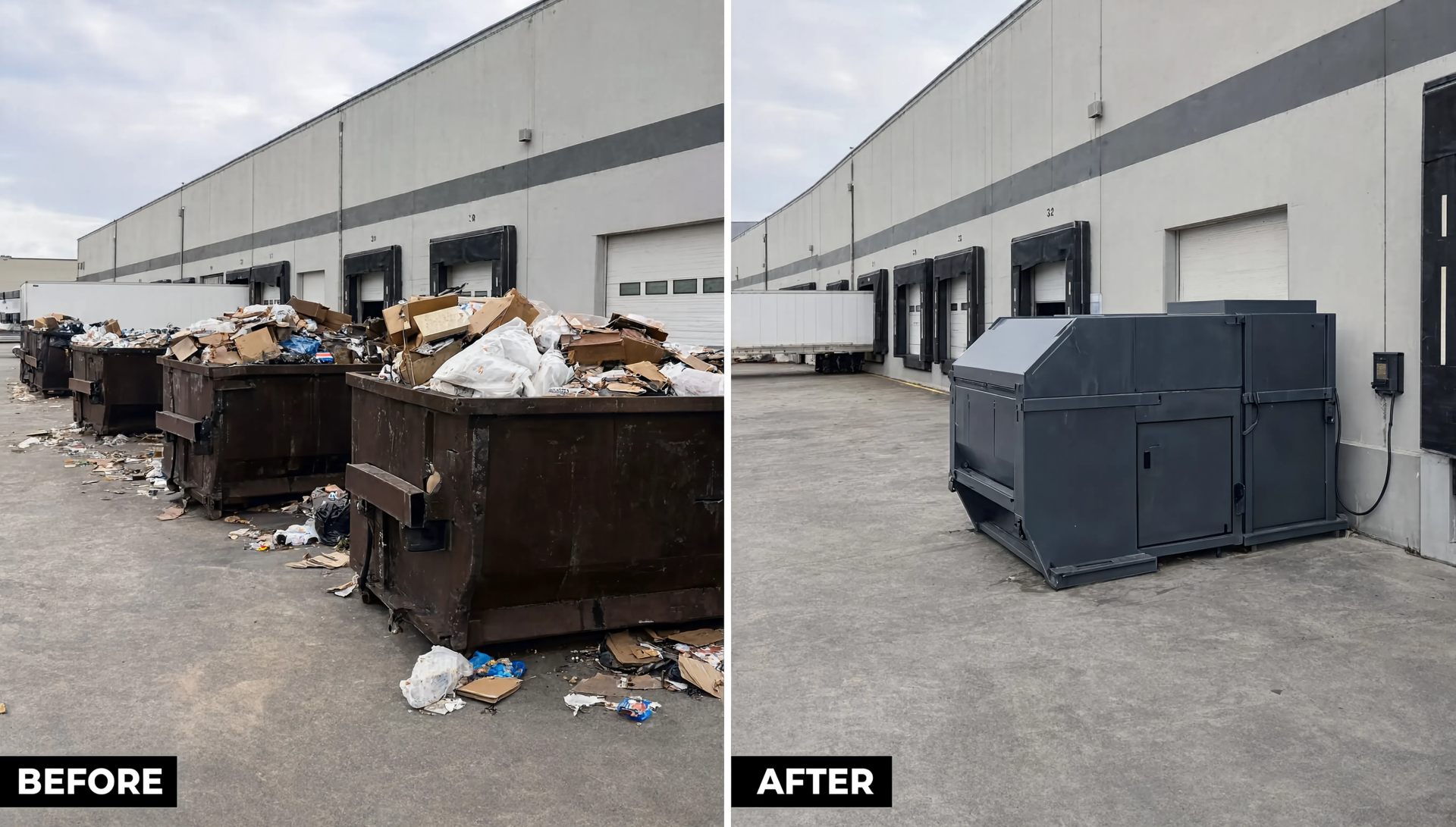
If your loading dock runs multiple dumpster pulls per week, the math on your waste management spend is working against you. Weekly rental fees compound. Mobilization charges stack up. Labor hours disappear into manual waste consolidation that a hydraulic ram could handle in seconds. Compare upfront costs, monthly operational expenses, hauling frequency differences, and realistic ROI timelines to build a defensible financial case for your facility.
A proactive commercial waste management plan does more than keep the loading dock tidy. It directly targets monthly waste management costs, hauler contract terms, and labor savings. The decision between a stationary compactor and a traditional roll-off dumpster sits at the center of that strategy for properties managing a high-volume waste stream.
Understanding your waste stream makeup matters before committing to either path. According to the EPA’s national MSW data, the U.S. generated 292.4 million tons of municipal solid waste in 2018. The breakdown of what fills commercial containers skews heavily toward materials that compact well:
- Paper and paperboard represent the largest single material category at 23.1% of total generation: 67.4 million tons in 2018.
- Food waste accounts for 21.6% (63.1 million tons), though this stream is better suited for self-contained units than stationary compactors.
- Plastics make up 12.2% (35.7 million tons), much of which is rigid packaging and film that compresses under hydraulic pressure.
For commercial properties dominated by cardboard, paper, and dry packaging, such as retail distribution centers, office complexes, or manufacturing facilities, the stationary compactor argument gets stronger the moment you map your waste composition against your current hauling schedule.
Direct Cost Comparison: Stationary Compactor vs. Traditional Dumpster
Dumpsters carry a misleadingly low entry cost. There is no capital outlay, no installation, and no maintenance obligation on your end. What they carry instead is a recurring cost structure that scales with your waste volume, and that structure rarely scales in your favor.
A 40-cubic-yard roll-off dumpster runs $576.80 per week in baseline rental, with a mobilization and demobilization fee of $111.24 per unit, according to federal feasibility cost estimates. At two pulls per week, you are looking at over $1,150 in rental fees alone before a single variable charge hits the invoice. A stationary compactor compresses dry waste into a detachable container, lowering haulage frequency. This reduction builds the financial case.
The table below compares both systems across the four metrics that matter most for a capital justification:
| Metric | Traditional Roll-Off Dumpster | Stationary Compactor |
|---|---|---|
| Upfront Cost | $111.24 mobilization fee per unit (no capital purchase) | $5,000 to $12,000 for certified used/rebuilt equipment; higher for new systems |
| Monthly Cost | $576.80/week baseline rental + variable hauling, fuel surcharges, and tipping fees | Amortized lease or purchase payment + minor electrical costs; hauling costs drop sharply |
| Hauling Frequency | Multiple pulls per week at high-volume properties | Significantly reduced: compaction consolidates volume so fewer pulls are needed |
| ROI Timeline | None: ongoing, open-ended expense with no break-even point | Typically 12 to 24 months depending on waste volume and current hauling frequency |
What a Dumpster Invoice Actually Contains
The flat weekly rental figure is rarely the full story. Commercial dumpster invoices typically layer variable charges on top of the base rental: fuel surcharges, environmental fees, overage charges when containers exceed weight limits, and additional pull fees when pickup frequency increases. These charges fluctuate with fuel prices, regional disposal rates, and hauler contract terms, which makes budgeting for them difficult. You can negotiate the base rental, but the variable line items are largely outside your control.
Transitioning to a stationary compactor shifts that dynamic. Compaction gives you direct visibility into waste output. You can schedule pulls based on actual container fullness rather than a fixed calendar. This control is the core of commercial waste control; you schedule services around actual operational needs rather than the hauler’s route efficiency.
Upfront Investment and Installation Costs
The capital cost of a stationary compactor is the number that gives most facility managers hesitation. It is worth examining closely rather than treating it as a barrier. The equipment purchase is only one component of the total installation cost. Other factors influence the final price.
- Equipment purchase: Certified used and rebuilt stationary compactors from Action Compaction Equipment’s inventory are priced from $5,000 to $12,000. These units are professionally inspected, have worn components replaced, receive in-house painting, and carry a six-month warranty. New systems vary based on specifications, ram pressure ratings, and container configurations.
- Site preparation: Most installations require a reinforced concrete pad and a dedicated 3-phase electrical hookup to handle the hydraulic ram’s power draw. Concrete pad thickness, clearance zones, and electrical panel capacity all factor into site prep costs, which vary by property.
- Professional installation: These steps add to the total. Action Compaction handles installation as part of their service offering, which removes the coordination burden from your facilities team.
The rebuilt equipment tier deserves more attention than it typically gets in capital planning discussions. A professionally inspected and warranted unit at $5,000 to $12,000 carries significantly lower acquisition risk than the sticker price on new equipment suggests. The six-month warranty covers the period when installation-related issues are most likely to surface. The in-house rebuild process means worn hydraulic components, seals, and structural elements are replaced before the unit ships, rather than being discovered after it is bolted to your pad.
Ongoing Operational Expenses and Hauling Fees
Once a stationary compactor is installed, its ongoing cost profile looks very different from a dumpster service contract. The contrast is not just about the monthly dollar figure: it is about which costs are fixed and which are variable.
- Dumpster fees: At $576.80 per week for a 40-cubic-yard roll-off, a property running two pulls per week pays over $2,300 per month in base rental alone, plus the $111.24 mobilization fee per unit and any applicable variable surcharges (per the EPA federal feasibility cost data).
- Compactor power consumption: The electrical draw of a stationary compactor’s hydraulic ram adds a modest, predictable line item to your monthly utility bill: far below the cost of a single dumpster pull.
- Hauling frequency savings: Compaction consolidates dry waste into a significantly reduced volume, meaning your hauler pulls a full container far less often. Fewer pulls mean fewer pull fees, fewer fuel surcharges, and fewer mobilization charges.
Selecting the right unit for your waste stream and volume is where the ongoing cost story gets specific. Reviewing commercial waste compaction equipment options by industry and facility size helps match ram pressure and container capacity to your actual throughput. This determines your pull frequency.
Ready to run the numbers? Action Compaction Equipment’s Sales and Service Team works with commercial properties across the United States to evaluate waste volume, current hauling costs, and the right equipment configuration. Call 801-565-1033 to start a no-pressure conversation about what compaction could realistically save your operation.
Calculating Your Return on Investment (ROI) Timeline
The ROI calculation for a stationary compactor is direct, even if the variables vary by property. Take your current monthly hauling spend (base rental, pull fees, surcharges, and any labor costs tied to manual waste consolidation) and compare it against the amortized monthly cost of the compactor (purchase price divided over your intended ownership period, or a lease payment) plus the reduced hauling costs you expect after installation. This gap represents your monthly savings. Divide the total equipment and installation cost by that monthly savings figure to find your break-even timeline.
For properties generating enough dry waste to warrant multiple pulls per week, the ability to minimize your waste footprint through compaction produces a break-even point well within two years. You achieve floor space reclamation and lower haulage frequency. The 12 to 24 month ROI window cited across the industry reflects properties where hauling frequency drops substantially after installation: not marginal reductions, but the difference between pulling twice a week and pulling twice a month.
“Measuring and understanding the types and quantities of waste produced allows facility managers to negotiate hauling services that align with actual needs, thereby reducing unnecessary hauling costs.” – EPA Managing and Reducing Wastes: A Guide for Commercial Buildings
This principle drives the ROI case. Properties that audit their waste stream before purchasing a compactor negotiate better hauler contracts, right-size their container capacity, and avoid over-specifying equipment. The audit step costs nothing and sharpens every number in the ROI model.
A stationary compactor is also a long-term durable asset engineered for years of heavy commercial use. Unlike a dumpster service contract, which you are perpetually paying into with no equity accumulation, the compactor retains operational value across its service life. The ROI timeline accounts for the purchase cost, but the ongoing savings continue well beyond the break-even point.
Space, Volume, and Property Requirements
Loading dock real estate is expensive in a way that rarely shows up on a waste management invoice. Every square foot occupied by a cluster of open-top dumpsters is a square foot unavailable for staging, receiving, or equipment movement. A single stationary compactor consolidates that footprint into one defined installation zone, freeing the surrounding area for productive use.
The physical requirements for installation are precise. Most industrial stationary compactors require a reinforced concrete pad, typically 6 inches thick, to handle the unit’s operating weight and the dynamic load of the hydraulic ram cycling under pressure. Clearance zones for haul trucks must be factored into the site plan: the truck needs unobstructed access to hook and pull the container, which means the installation location cannot be tucked into a corner that works for a dumpster but blocks a 40-foot trailer. Electrical access for the 3-phase hookup needs to be within practical conduit distance of the installation point. Plan this placement carefully.
Reducing hauling frequency also has a pavement preservation benefit that does not always make it into the financial model. Heavy waste trucks exert substantial stress on commercial parking lots and loading dock aprons with every visit. A property that cuts its hauler visits from eight or ten times per month to two or three significantly reduces the cumulative pavement wear those trucks generate, extending the service life of asphalt and concrete surfaces and deferring repair costs that can run into the thousands.
For site planning, Action Compaction provides detailed equipment specifications to help your facilities team evaluate fit before committing to installation. Review the RJ-225 & RJ-225HD Marathon Specs and RJ-325 & RJ-325HD Marathon Specs to assess ram pressure ratings, container dimensions, and footprint requirements against your available dock space.
Rental and Leasing Options for Commercial Properties
Not every commercial property can absorb a $5,000 to $12,000 capital outlay in a single budget cycle, and that is a legitimate constraint, not a reason to default back to open-ended dumpster costs. Several financial options make compaction accessible without requiring full upfront capital. These options ease the transition.
- Leasing programs: A lease amortizes the equipment cost over multiple years, converting a capital expense into a predictable monthly payment. When that monthly payment is offset by the reduction in hauling costs, the net cash flow impact can be neutral or positive from the first month.
- Rental rates: Stationary compactor rental arrangements keep capital fluid and allow properties to evaluate operational fit before committing to ownership. Rental costs vary by contract terms.
- Used and rebuilt equipment: Certified pre-owned units from Action Compaction’s inventory, priced from $5,000 to $12,000, offer the lowest acquisition cost with the same professional inspection, component replacement, in-house paint, and six-month warranty as a new installation.
Maintenance, Service Intervals, and Hidden Fees
A stationary compactor carries maintenance obligations that a dumpster does not, and that is a fair point to put on the table. The question is whether those obligations represent a high cost relative to the savings, or whether they are a manageable part of owning any piece of industrial equipment.
Heavy-duty compactors operate on structured preventative maintenance intervals: 250 hours, 500 hours, 1,000 hours, and 2,000 hours of operation, each triggering specific inspection and service tasks to maintain hydraulic system integrity and structural performance. These intervals are consistent with federal maintenance specifications for heavy-duty compaction equipment. Skipping them shortens equipment life and increases the likelihood of unplanned downtime, which, on a busy loading dock, carries its own operational cost.
Action Compaction provides service seven days a week, including after-hours emergency support. For a facility running waste compaction as a core operational function, that service readiness matters. A compactor that goes down on a Friday afternoon does not have to wait until Monday for a technician.
The maintenance cost structure for a stationary compactor is also fundamentally different from dumpster variable fees. Maintenance intervals are predictable and schedulable. You can budget for them. The variable surcharges on a dumpster invoice (fuel adjustments, environmental fees, overage charges) arrive on the invoice after the fact, with limited ability to forecast or control them.
Is a Stationary Compactor Worth It for Your Business?
The direct answer is that it depends on volume, waste composition, and current hauling frequency, but those three factors tend to point in the same direction for most high-throughput commercial properties.
A stationary compactor makes strong financial sense when your property generates consistent, high-volume dry waste (cardboard, paper, rigid plastics, dry packaging) and schedules more than two dumpster pulls per week. At that frequency, the weekly rental and pull fee accumulation moves fast. It also makes sense when loading dock congestion is a real operational problem: multiple dumpsters occupying dock space, overflow creating sanitation or pest issues, or staff spending meaningful time on manual waste consolidation. Those are costs that do not always appear on a waste management invoice but show up in labor hours and facility condition. Properties that fit this profile (retail distribution, food manufacturing for dry waste streams, office campuses, hospitality facilities with high cardboard volume) typically find that the 12 to 24 month ROI timeline is achievable, sometimes faster when hauling frequency drops sharply after installation.
There is a case to be made that smaller properties with low waste volumes are better served by a right-sized dumpster service than by investing in compaction infrastructure. Compaction requires sufficient volume. If you are pulling a single dumpster once a week, the capital and installation cost of a compactor will not recover within a reasonable timeframe. The decision framework is simple: audit your current monthly hauling spend, map your waste composition, and count your weekly pulls. These points guide your decision.
Frequently Asked Questions About Commercial Waste Costs
What is the average upfront stationary compactor cost?
Upfront costs vary based on unit specifications, ram pressure rating, and container configuration. Certified rebuilt equipment from Action Compaction Equipment’s inventory commonly ranges from $5,000 to $12,000, which represents a lower-risk entry point than new systems for properties evaluating compaction for the first time. New equipment costs scale with specifications and are best quoted against your specific waste volume and container requirements.
How does a stationary compactor differ from a self-contained unit?
A stationary compactor is bolted to the ground and pushes dry, bulk waste into a separate detachable container that a hauler pulls when full. The compactor unit itself remains on-site. A self-contained compactor houses both the hydraulic ram and the waste container in one sealed unit, making it the correct choice for wet waste streams (food service, restaurants, facilities with significant liquid content) where leakage from a detachable container would create sanitation and compliance problems. For dry bulk waste, the stationary configuration is the standard choice.
Can you rent or lease a stationary compactor?
Yes. Leasing and rental programs are widely available for commercial stationary compactors, allowing properties to convert what would be a capital expense into a predictable monthly payment. In many cases, that monthly payment is partially or fully offset by the immediate reduction in hauling costs, particularly for properties currently running multiple pulls per week. Rental arrangements also allow facilities to evaluate operational fit before committing to long-term ownership.
What are the electrical and concrete requirements for installation?
Most industrial stationary compactors require a reinforced concrete pad, typically 6 inches thick, to handle operating weight and the dynamic load of the hydraulic ram under pressure. A dedicated 3-phase electrical hookup is standard, sized to handle the ram’s power requirements during cycling. Site-specific requirements vary by unit model; reviewing equipment spec sheets before finalizing a site plan avoids surprises during installation.
What are the typical pavement repair savings associated with reducing haulage frequency?
Heavy waste trucks impose significant cumulative stress on commercial parking lots and loading dock surfaces with every visit. A property that reduces hauler visits from eight or ten times per month to two or three removes a substantial portion of that recurring pavement load. Over time, that reduction extends the service life of asphalt and concrete surfaces, deferring repair and resurfacing costs that can reach thousands of dollars per cycle. Pavement preservation rarely appears in a waste management ROI model, but it is a real line item in a facility’s long-term capital plan.
The financial case for a stationary compactor is not built on a single dramatic number; it accumulates across reduced pull frequency, eliminated variable surcharges, reclaimed loading dock space, and labor hours redirected away from manual waste handling. For commercial properties generating consistent dry waste volume at high frequency, the compactor stops being a capital expense and starts functioning as a cost-reduction asset within the first one to two years. The dumpster service, by contrast, never stops being an expense. Every pull is a fee with no equity, no break-even, and no end date.
Explore Action Compaction’s new industrial trash compactors to find a system engineered to hold more waste than traditional dumpsters, reduce your hauling schedule, and maintain a cleaner, more organized facility. To discuss your specific waste volume and get a tailored equipment recommendation, contact Action Compaction Equipment’s Sales and Service Team at 801-565-1033. They serve commercial properties across the United States, seven days a week.
Recent Comments