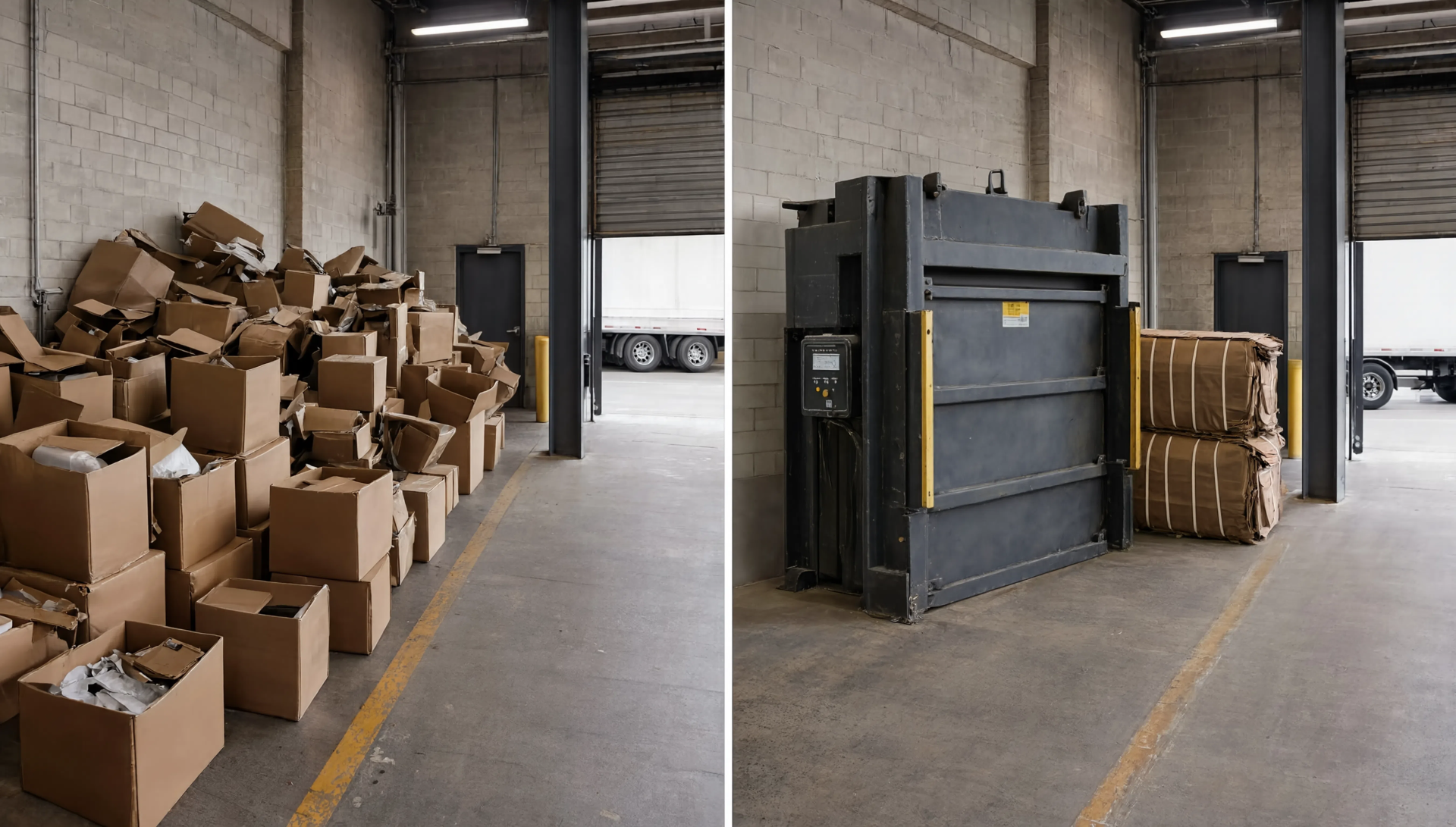
Most businesses treating cardboard as a disposal problem pay for that misclassification every single month. A commercial facility managing high-volume waste in the form of loose, uncompacted boxes is not just dealing with a messy loading dock: it is absorbing avoidable hauling fees, bleeding labor hours, and forfeiting commodity revenue that baled cardboard generates. A cardboard baler does more than tidy up the back of house. It stops the financial bleed. For many operations, it converts waste management from a recurring monthly expense into a cost-neutral or revenue-generating line item.
If you manage a warehouse, distribution center, retail backroom, or any facility processing substantial cardboard volume, the financial case for compaction equipment is clear. The baler uses hydraulic force to compress loose cardboard boxes into dense, stackable blocks called bales. Vertical balers are the industry standard for on-site compaction; they have a compact footprint, simple operator loading, and fit into most commercial backrooms without structural modifications. Used inventory equipment from Action Compaction Equipment LLC is priced from $5,000 to $12,000, which grounds the ROI conversation in a realistic capital outlay rather than an abstract figure.
Three financial levers drive the financial return on this equipment purchase:
- Direct haulage cost reduction: Compacted bales dramatically shrink waste volume, cutting the frequency of expensive dumpster pulls and eliminating overage fees.
- Labor hour reclamation: Eliminating manual box breakdown and repeated trips to outdoor bins frees employees for core operational work.
- Recycling commodity revenue: Clean, dense bales are a sellable commodity. Loose cardboard is not.
The True Cost of Loose Cardboard: Why Your Loading Dock is Drowning
Cardboard volume accumulates faster than most facility managers expect, eventually creating a loading dock bottleneck that blocks walkways, triggers sanitation compliance concerns, creates genuine fire hazard exposure, and slows down daily receiving operations. Loose boxes are bulky, unpredictable in shape, and nearly impossible to store compactly without dedicated labor. For retail and commercial operations managing high-volume waste, these pressures compound quickly, and the financial ramifications extend well beyond a cluttered floor. Understanding retail waste management solutions means recognizing that the physical disorder on the dock is a symptom of structural inefficiency, not just a housekeeping issue.
The core problem is spatial economics. Air is expensive to haul. Uncompacted cardboard occupies a disproportionate volume relative to its actual material weight. A facility filling a dumpster with loose boxes is, in practical terms, paying a hauler to transport air. That dumpster reaches capacity not because the facility generated a large mass of waste, but because the waste was never compressed. The result is inflated haulage frequency: more pickups, more fees, and more overage charges when boxes overflow before the scheduled pull. Implementing proper cardboard recycling practices, starting with compaction at the source, is the most direct intervention available to interrupt that cost cycle. Reducing haulage frequency is not a marginal efficiency gain; for high-volume operations, it is the single largest controllable line item in the waste management budget.
Hauling Cost Reduction
The financial mechanics of hauling cost reduction are direct. Compacting loose cardboard into dense bales reduces waste volume significantly, which means fewer scheduled dumpster pulls and a smaller physical footprint for waste storage. The exact reduction in haulage frequency varies by facility, depending on baseline cardboard volume, current dumpster size, and pickup schedule, but the directional outcome is consistent: compacted waste requires fewer pickups than loose waste, and fewer pickups translate immediately to lower monthly hauling invoices.
- Fewer dumpster pulls: A baler consolidates what previously filled multiple pickups into far fewer. The specific reduction depends on your facility’s baseline volume, but the mechanism is direct: dense bales occupy a fraction of the space that loose boxes consume.
- Elimination of overage fees: Loose cardboard overflows dumpsters. This triggers costly penalties. Haulers charge overage or overfill penalties when bins exceed capacity before a scheduled pull. A baler eliminates this exposure entirely by keeping material compressed and contained.
- Dumpster downsizing: By diverting cardboard from the general waste, many facilities can reduce their dumpster size or eliminate supplemental bins, cutting monthly rental fees in the process.
Labor Savings
Manual cardboard breakdown is one of the most undercosted labor expenses in commercial operations. Employees spend time every shift using utility knives to flatten boxes, carrying loose material to outdoor bins, and making repeated trips across the facility floor. None of that time shows up as a discrete line item on a P&L, which is precisely why it endures: it is absorbed into general labor costs and treated as an operational given rather than an inefficiency with a fix.
- Eliminating manual breakdown: A cardboard baler accepts whole, unflattened boxes. Workers feed material directly into the chamber without pre-processing, removing the utility knife step and the physical effort of flattening entirely.
- Reduced transit time: A vertical baler installed near the source of waste, whether in a retail backroom, near a receiving area, or adjacent to the loading dock, eliminates repeated trips to outdoor dumpsters. Staff stay on the floor.
- Labor hour reclamation: Hours recovered from waste handling redirect to inventory management, restocking, receiving, or customer-facing work. The throughput gain is real and immediate.
- Workplace safety and injury reduction: Repetitive cutting and lifting of loose cardboard piles generates strain injuries over time. A baler automates the compaction force, reducing the physical demands on operators and lowering workers’ compensation exposure.
Is your loading dock bottleneck costing you valuable time and money? Let our Sales and Service Team help you analyze your high-volume waste. Contact Action Compaction Equipment at 801-565-1033 to design a custom waste reduction workflow that fits your facility’s physical footprint and budget.
Rebate Revenue
Loose cardboard has no commodity value to recycling processors. It is expensive to transport, prone to contamination from moisture and mixed materials, and inefficient to handle at the mill. Baled cardboard is a different product entirely. It has real value. Recycling centers pay for clean, dense, well-prepared bales because they load directly onto flatbeds, ship efficiently to paper mills, and arrive in a condition that processors can use immediately.
The commodity traded is Old Corrugated Containers (OCC), and its market price fluctuates dynamically based on regional supply, export demand, and mill capacity. Fabricating a current price range would mislead rather than inform; OCC pricing shifts meaningfully across quarters and geographies. What does not change is the principle: baled OCC always commands a higher market rate than loose material, because the baling work has already been done and the processor’s handling costs drop accordingly. Facilities that produce clean, consistent bales position themselves to receive the maximum available rate from local recycling processors.
Qualifying for recycling rebates requires meeting the processor’s bale specifications. Bale weight and density vary based on the physical dimensions of the baler chamber, where a 36-inch, 48-inch, or 60-inch model will produce bales of different sizes, and the hydraulic pressure the baler applies. Most processors also require a minimum quantity before scheduling a pickup, often a full truckload, which means facilities need adequate floor space to stockpile completed bales between collections. That storage consideration belongs in the equipment selection conversation, not as an afterthought.
“In modern facility logistics, waste is no longer just an operational byproduct; it is a resource. By compacting cardboard at the source, businesses stop paying to haul empty space and start capturing the raw commodity value of their waste.”
ROI Comparison by Business Size
The ROI profile of a cardboard baler shifts significantly depending on the scale of the operation, and it is worth being precise about where the return actually comes from at each tier.
Small-to-medium facilities, including retail stores, grocery operations, cafes, and medical offices, typically face tight floor space and moderate cardboard volume. For these businesses, the primary financial driver is not recycling revenue: it is hauling cost reduction. A compact vertical baler allows them to reclaim floor space, cut haulage frequency, and eliminate overage fees. The savings are directly proportional to their current hauling costs, and for facilities paying meaningful monthly disposal fees, the reduction can represent a substantial percentage of their operational overhead. Recycling rebates may be secondary or minimal if volume does not support regular truckload pickups, but the waste bill reduction alone often justifies the equipment cost.
Large-scale facilities, such as distribution centers, manufacturing plants, and regional warehouses, operate a different equation. High throughput means cardboard volume measured in tons per week, not boxes per day. The scale is massive. For these operations, ROI combines all three levers simultaneously: significant labor hour reclamation across multiple shifts, consistent recycling rebate revenue from regular bale pickups, and substantial landfill diversion that supports corporate sustainability reporting. These facilities often move to heavy-duty horizontal balers, which handle continuous high-volume waste through automated conveyor loading and automatic bale tying, rather than the manual-load vertical format suited to smaller operations.
Ready to stop paying to haul air? Action Compaction Equipment LLC offers a wide range of waste compaction equipment, including high-quality Used Inventory Equipment priced from $5,000 to $12,000. Our Sales and Service Team is available seven days a week, including after-hours emergency support, to keep your operations running smoothly. Call us today at 801-565-1033 to explore our inventory.
Payback Period Calculator
Calculating the break-even point on a cardboard baler does not require a financial model: it requires honest numbers from your own operation. Work through these steps with your actual invoices and labor records:
- Calculate current monthly waste costs: Pull every fee associated with cardboard disposal, including dumpster rental, haulage frequency charges, overage penalties, and any supplemental bin costs. This is your baseline disposal expense. Know your starting point.
- Estimate monthly labor costs: Track the hours employees spend breaking down boxes and hauling material to outdoor bins across a typical week, then multiply by their hourly wage. Most operations underestimate this figure until they measure it directly.
- Determine equipment acquisition costs: Factor in the purchase price, where used equipment from Action Compaction Equipment LLC runs from $5,000 to $12,000, or calculate monthly leasing fees if financing the baler.
- Project post-baler savings: Estimate reduced hauling fees based on the haulage frequency reduction you expect, and calculate the labor hours your team will recover. Add any projected recycling rebate revenue if your volume supports it.
- Calculate the payback period: Divide the total upfront equipment cost by the net monthly savings. The result is the number of months to break even. For many commercial operations, that number lands well within the equipment’s operational lifespan.
Download our detailed baler machine cost guide and interactive ROI worksheet [MISSING: downloadable asset] to input your facility’s specific waste volume and calculate your exact payback period.
Choosing the Right Equipment: Vertical vs. Horizontal Balers
Equipment selection determines how much of the theoretical ROI your facility actually captures, so the vertical versus horizontal decision deserves a direct treatment.
Vertical cardboard balers compress material downward using a hydraulic ram. Operators load loose cardboard through a front-opening chamber, cycle the ram, and tie off the completed bale manually with baling wire before ejecting it. Their footprint is compact: they fit in retail backrooms, hospital receiving areas, and smaller warehouse spaces where floor real estate is limited. Used vertical balers from Action Compaction Equipment LLC are available from $5,000 to $12,000, making them an accessible entry point for facilities that want to capture hauling cost savings without a large capital commitment.
Horizontal cardboard balers are engineered for continuous, high-volume waste. Material feeds automatically via conveyor belt or air-trim system, and most models include automatic bale tying, removing the manual operator step entirely. They require significantly more floor space and a larger capital investment than vertical models, but for distribution centers and manufacturing operations processing tons of cardboard daily, the throughput advantage is compelling.
Paper and paperboard, the category that includes corrugated cardboard, consistently ranks among the largest components of municipal solid waste generated in the United States, according to EPA facts and figures on municipal solid waste. That volume represents both a disposal burden and a recoverable resource, and the right compaction equipment is what determines which side of that equation your facility lands on.
Hidden Operational Factors: Maintenance, Safety, and Footprint
The true cost of ownership extends beyond the purchase price, and facilities that ignore the operational layer often see their ROI erode faster than expected.
Preventive maintenance on hydraulic machinery, including regular inspections, oil changes, cylinder checks, and seal replacements, is not optional. A baler running on neglected hydraulics will eventually fail mid-shift, and emergency repair costs can quickly offset months of hauling savings. Scheduled maintenance is the mechanism that keeps the payback period calculation honest over the equipment’s lifespan.
Safety and compliance carry their own financial stakes. Modern balers include dual-hand controls and door safety interlocks as standard features, but operator training and proper baler guarding are legal requirements, not optional add-ons. OSHA machine guarding standards require that all machinery with moving parts be properly guarded to prevent contact injuries. Non-compliance exposes facilities to regulatory fines that dwarf the cost of proper training and guarding; workers’ compensation claims from baler-related injuries carry their own long-term cost implications.
Electrical and spatial requirements need confirmation before equipment delivery. Larger vertical and horizontal balers typically require 3-phase power, and facilities running single-phase electrical infrastructure may need an upgrade. Ceiling clearance matters too: a vertical baler’s ram extends upward during the compression cycle, and insufficient overhead clearance can make certain models physically incompatible with your facility’s backroom or loading dock. These are not deal-breakers, but they belong in the pre-purchase conversation, not the post-installation surprise.
Frequently Asked Questions About Cardboard Baler ROI
What is a cardboard baler and how does it physically operate?
A cardboard baler is industrial compaction equipment that uses a heavy hydraulic ram to compress loose cardboard boxes into dense, uniform blocks. Operators load loose cardboard into the chamber, close the safety gate, and cycle the ram. The process is simple. Once the chamber is full, the compressed cardboard is secured with baling wire, and the completed bale is ejected onto a pallet for storage and transport.
How much is 1,000 pounds of cardboard worth in the recycling market?
The value of 1,000 pounds, or roughly a half-ton, of cardboard fluctuates constantly based on regional commodity market demand for Old Corrugated Containers (OCC). Prices shift with export demand, mill capacity, and regional supply. Markets change daily. What remains consistent is that producing clean, dry, and tightly compacted bales ensures your business receives the highest possible market rate from local recycling processors, compared to loose or contaminated material.
How long does it take to bale cardboard during a typical shift?
The physical compaction cycle of a vertical baler typically takes between 30 to 45 seconds per ram cycle. Producing a complete bale, which involves loading multiple batches of cardboard and tying off the finished bale, generally requires 30 to 60 minutes of collective labor, depending on the baler’s chamber capacity and the operator’s experience level.
Is baled cardboard worth anything if we don’t have high-volume waste?
Yes, but the primary return for low-volume businesses is not recycling revenue: it is waste hauling cost reduction. Compacting cardboard drastically reduces waste volume, allowing facilities to cut haulage frequency and eliminate overage fees. That reduction provides immediate, predictable monthly savings regardless of whether the operation generates enough bale volume to qualify for regular recycling pickups.
How much does a cardboard baler cost to maintain annually?
Annual maintenance costs are relatively low, typically involving routine inspections, lubrication, and occasional hydraulic oil top-offs. Partnering with an experienced service provider keeps those costs predictable and prevents the expensive emergency repairs that come from deferred maintenance. Action Compaction Equipment LLC provides service seven days a week, including after-hours emergency support, to minimize operational downtime and protect your equipment purchase.
Purchasing a cardboard baler is a direct path to reclaiming control over your facility’s waste management costs. By converting a cluttered loading dock bottleneck into an efficient, streamlined recycling workflow, your business eliminates unnecessary hauling fees, reclaims valuable labor hours, and establishes a sustainable operational footprint.
Let our Sales and Service Team design a custom waste reduction workflow tailored to your facility’s unique throughput. Contact Action Compaction Equipment LLC today at 801-565-1033 or visit our facility at 5415 W 700 S to discuss our new and used equipment inventory. We provide service seven days a week, including after-hours emergency support, ensuring your operations never grind to a halt.
Recent Comments